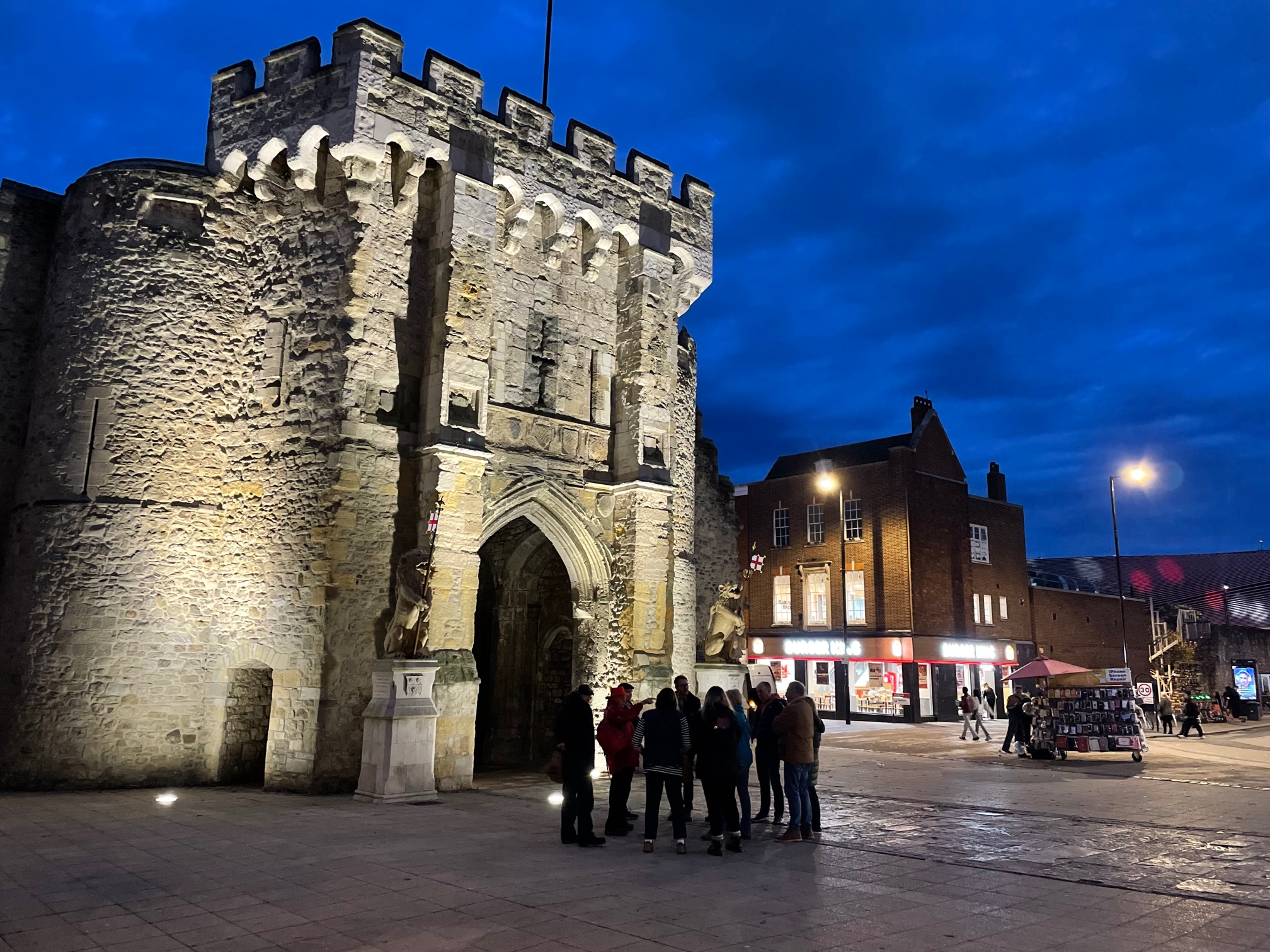
The Bargate in Southampton
The most complex Medieval gateway in England?
Standing proudly at the northern entrance to Southampton's Old Town, the Bargate is one of the city's most recognisable landmarks. For more than 840 years, this remarkable medieval gateway has welcomed merchants, monarchs, soldiers and visitors into the city. Today, thousands of people still pass beneath its ancient archway every week, often unaware of the extraordinary history contained within its stone walls.
Architectural historian Sir Nikolaus Pevsner described the Bargate as "probably the finest, and certainly the most complex, town gateway in Britain." He also argued that Southampton's medieval town walls were even more interesting than those at York or Conwy, a remarkable accolade considering those cities are far better known for their fortifications.
Built to protect a prosperous Medieval port
The Bargate was originally constructed around 1180 from stone and flint as the principal entrance into the walled town of Southampton. At the time, Southampton was one of England's busiest ports, handling valuable imports including wine from France and luxury goods from across Europe.
As the town's wealth grew, so too did its defences. Around 1290, the Bargate was strengthened with two impressive drum towers on its northern side, complete with arrow slits to defend against attack. The gateway became not only a defensive structure, but also a powerful symbol of Southampton's importance.
More than just a gateway
Over the centuries, the Bargate has served many different purposes.
Its upper floors housed Southampton's original Guildhall, where merchants gathered to conduct business and make important decisions affecting the town. The ground floor also served as a prison for hundreds of years. Records show repairs to prison bolts in 1439, while in 1458 several Genoese merchants living in Southampton found themselves imprisoned within its walls.
The prison remained here until the Georgian period before eventually moving to God's House Tower, allowing new pedestrian passages to be cut through either side of the main arch to improve access through the busy gateway.
Witness to history
Few buildings in Hampshire have witnessed so many significant moments.
In 1346, King Edward III's army marched through the Bargate on its way to the Battle of Crécy. Nearly seventy years later, Henry V's troops passed beneath the same arch as they departed for the campaign that would culminate in the famous victory at Agincourt.
In 1529, Henry VIII publicly announced from the Bargate his condemnation of the writings of Martin Luther.
The gateway later welcomed both Charles I and Charles II, while soldiers marched beneath it during both the First and Second World Wars.
During the Southampton Blitz, the Bargate took on yet another role, serving as an air-raid shelter for local residents seeking refuge during the devastating bombing raids.
Part of one of England's finest Medieval defences
The Bargate is only one section of Southampton's remarkable medieval defences.
Large sections of the city walls still survive today, stretching for almost a mile and making them the third longest continuous medieval town walls in Britain. York has approximately 2.1 miles (3.4 km) of almost complete medieval walls, making them the longest in England and the UK and Conwy has approximately 0.8 miles (1.3 km) of almost completely intact town walls, regarded as the finest surviving complete circuit of medieval walls in Britain and a UNESCO World Heritage Site.
Alongside the walls in Southampton lie numerous medieval vaults, once used by merchants to store imported wine at a constant temperature before it was sold throughout England. Join one of our popular tours to explore a selection of these vaults.
Together, these walls, towers and vaults create one of the country's finest surviving medieval townscapes.
A narrow escape?
It is almost impossible to imagine Southampton without the Bargate, yet at the beginning of the twentieth century its future looked uncertain.
When electric trams were introduced in 1900, serious proposals were put forward to demolish the gateway altogether. Some suggested using its stone to reclaim land along the Western Shore, while others proposed dismantling and rebuilding it elsewhere, including Houndwell Park.
Fortunately, wiser heads prevailed and the Bargate was preserved. Today it remains the symbolic heart of Southampton's Old Town and forms the centrepiece of the city's ongoing regeneration.
A royal gateway?
It's often said that every English king and queen since the Bargate was built has passed beneath this arch. While historians can't prove that for every monarch, we do know that many certainly did, including Edward III, Henry V, Henry VIII, Charles I and Charles II. For centuries this was the main gateway into one of England's most important ports.
The Medieval Merchant's House
Just a short walk from the Bargate stands another of Southampton's medieval treasures: the Medieval Merchant's House.
Built around 1290 by the prosperous merchant John Fortin, it is one of the finest surviving merchant's houses in England. Like many wealthy Southampton merchants, Fortin built in stone at a time when the town was becoming increasingly prosperous through international trade.
The house includes a vaulted undercroft used to store wine, while its upper floor projects over the street to create additional living space.
Remarkably, the building survived centuries of domestic and commercial use before bomb damage during the Southampton Blitz revealed much of its medieval interior. Careful restoration in the 1980s returned it to something close to its original appearance, and today it is cared for by English Heritage.
Historian Glyn Coppack described it as "the only building of its type to survive substantially as first built," making it one of the most significant medieval houses anywhere in Britain.
Discover Southampton's hidden Medieval history
The Bargate is much more than an impressive gateway. It is a reminder of Southampton's importance as one of medieval England's greatest ports and a building that has stood at the centre of the city's story for more than eight centuries.
Whether you're admiring its imposing towers, exploring the nearby medieval walls and vaults, or visiting the Medieval Merchant's House, you'll discover that Southampton possesses one of the richest collections of medieval architecture anywhere in the country.
If you'd like to uncover even more of Southampton's hidden history, why not join one of our guided walking tours? Led by passionate local guides, you'll discover secret medieval vaults, fascinating stories and remarkable places that many visitors – and even local residents – walk past every day without realising their significance.
Sign up to News & Offers
Be first to hear about unique new activity providers, artisans, hosts, and local experts